
Republic Act No. 8792
What are the Selient Features of this Act?
Republic Act 8792, was signed into law last June 14, 2000. It is a landmark legislation in the history of the Philippines. Not only has this bill made the country a legitimate player in the global marketplace. The Philippine Internet community has played a major role in pushing for its passage. The law took effect last June 19, 2000.
With the Philippines relaxed stock market listing rules plus a proposed vibrant investment priorities program in place, Filipinos here and abroad, and its foreign partners, have something to look forward for.
Here are the salient features of Republic Act 8792:
1. It gives legal recognition of electronic data messages, electronic documents, and electronic signatures. (section 6 to 13)
2. Allows the formation of contracts in electronic form. (section 16)
3. Makes banking transactions done through ATM switching networks absolute once consummated. (section 16)
4. Parties are given the right to choose the type and level of security methods that suit their needs. (section 24)
5. Provides the mandate for the electronic implementation of transport documents to facilitate carriage of goods. This includes documents such as, but not limited to, multi-modal, airport, road, rail, inland waterway, courier, post receipts, transport documents issued by freight forwarders, marine/ocean bill of lading, non-negotiable seaway bill, charter party bill of lading. (section 25 and 26)
6. Mandates the government to have the capability to do e-commerce within 2 years or before June 19, 2002. (section 27)
7. Mandates RPWeb to be implemented. RPWeb is a strategy that intends to connect all government offices to the Internet and provide universal access to the general public. The Department of Transportation and Communications, National Telecommunications Commission, and National Computer Center will come up with policies and rules that shall lead to substantial reduction of costs of telecommunication and Internet facilities to ensure the implementation of RPWeb. (section 28)
8. Made cable, broadcast, and wireless physical infrastructure within the activity of telecommunications. (section 28)
9. Empowers the Department of Trade and Industry to supervise the development of e-commerce in the country. It can also come up with policies and regulations, when needed, to facilitate the growth of e-commerce. (section 29)
10. Provided guidelines as to when a service provider can be liable. (section 30)
11. Authorities and parties with the legal right can only gain access to electronic documents, electronic data messages, and electronic signatures. For confidentiality purposes, it shall not share or convey to any other person. (section 31 and 32)
Can you relate some provisions of the Law on your past experiences as an IT student.
i can relate to the section 8 of the law because it is very convinient. I have a field experience in the past as an operation manager in a IT dompany which develops websites and i find this very helpful specially when our clients are very far and we only communicate through internet. Well we are still a business and legal documents are stil needed so this is very convinient for onliune transactions.
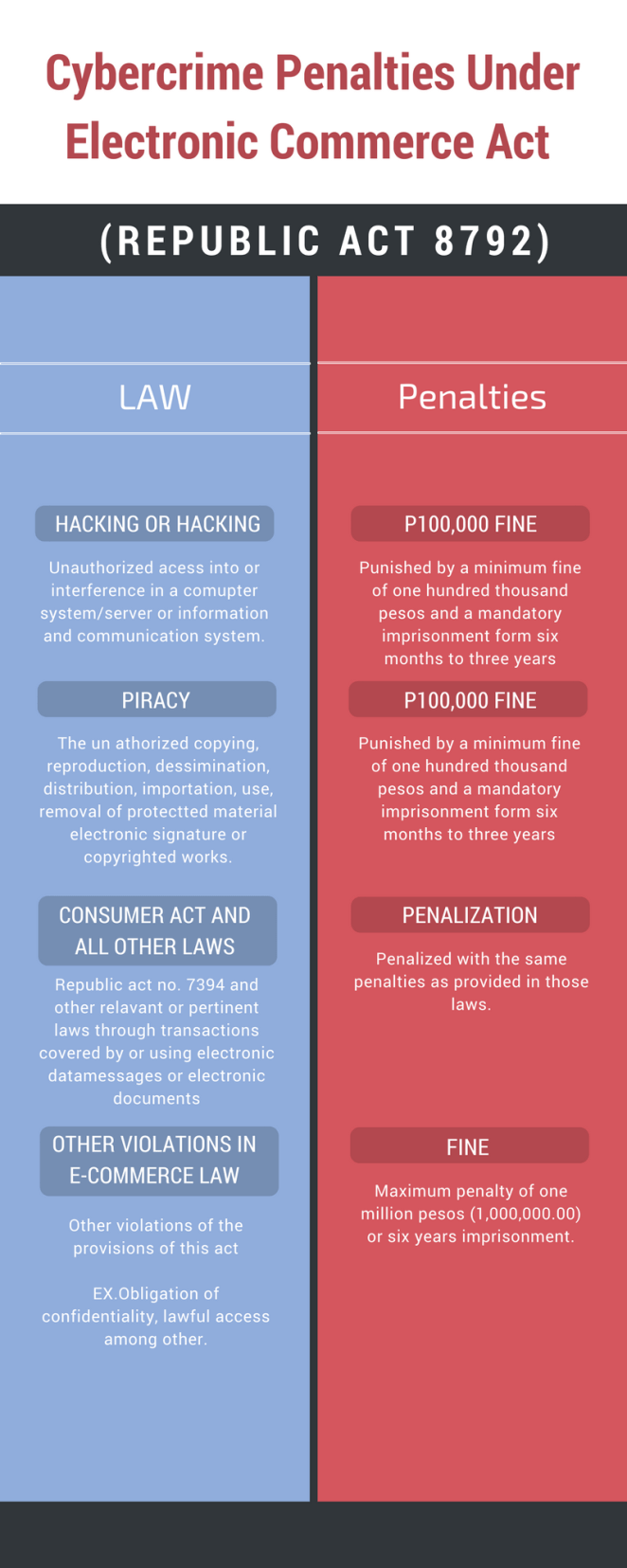
Create an Info-graphic about this Law.
 jesrealm